


NG eCall & RTT – real-time communication
As digitalisation advances, emergency call communication is undergoing a fundamental transformation. Two technologies are taking centre stage: Next Generation eCall (NG eCall) and Real-Time Text (RTT). Both innovations open new possibilities for control centres — enabling faster information transfer, greater availability, and barrier-free communication. This brings key questions into focus for decision-makers: What requirements will emerge? What opportunities will arise? And how can control centres be made future-proof for the long term?
NG eCall – the next step in automatic emergency call systems
The automatic emergency call system eCall has been mandatory for all new vehicle types in the EU since 2018. Until now, it was based on circuit-switched 2G and 3G technologies. With the introduction of NG eCall, transmission is now IP-based via LTE and 5G networks. For control centres, this means that data and voice connections are not only more stable, but also faster and of higher quality.
One key advantage is that the minimum data set (MSD), which includes information on the vehicle type, identification number and exact location, is already available at the control centre when the call comes in. This means that critical information is available immediately, even before the call is answered. The usual transmission time is eliminated, and voice communication and manual queries can be carried out in parallel without delay.
At the same time, new infrastructure requirements arise:
- Control centres need SIP-based emergency lines and trunks for callbacks.
- An IP-enabled communication environment is becoming the standard.
- Transition phases must be taken into account, as classic eCalls from already approved vehicles will remain in use for a long time.
From 1 January 2026, all new cars coming onto the market in Europe must be equipped with eCall devices. From 2027, only new vehicles with NG eCall-enabled equipment may be delivered. This means that there will be a transition period during which both systems will have to be supported in parallel. This aspect must be taken into account in control centre planning.
Focus on interoperability – experiences from the NG eCALL plugtests
The Europe-wide introduction of NG eCall requires a high degree of standardisation and interoperability. Plug tests such as those conducted in Bonn in June 2025 demonstrate how essential cooperation between vehicle manufacturers, network operators and control centre providers is. More than 2,500 tests within four days highlighted the range of interface issues, particularly with regard to recall behaviour and manual MSD queries.
Such test series underscore that NG eCall is not only a technical challenge, but also an organisational one. Only when all parties involved – from the automotive industry to control centre infrastructure – work in harmony can the full benefits for citizens and emergency services be realized.
Real-Time Text (RTT) – barrier-free communication in real time
Alongside NG eCall, Real-Time Text (RTT) is becoming increasingly important. The aim is to enable barrier-free emergency calls regardless of hearing or speech ability. RTT transmits text character by character in real time, embedded in the IP-based voice connection and based entirely on SIP standards.
This has several advantages for control centres:
• Inclusion: Deaf, hard-of-hearing and speech-impaired people gain direct access to emergency services.
• Flexibility: Text and voice communication can be combined, for example in noisy environments or for silent emergency calls.
• Efficiency: Fax-based solutions are replaced, media breaks are avoided and GDPR-compliant communication is ensured.
Particularly relevant: citizens do not need special apps or thirdparty services. Access is provided via native operating system functions or web clients – quickly, easily and independently of commercial platforms.
From 2027, RTT support will be mandatory in control centres across the EU. The first platforms, including eurofunk communication systems, will offer this function as early as 2026.
The introduction of RTT is also changing control centre processes. Text communication is being integrated into dispatcher interfaces, where predefined modules – for example, for W-questions – are available in addition to free text input. At the same time, communication is recorded and can be used for research and documentation purposes.
The ability to centrally document and evaluate text messages as well as voice communications makes the work of emergency services easier and creates additional transparency. Standardised interfaces also ensure that RTT can be seamlessly integrated into existing command and control systems.
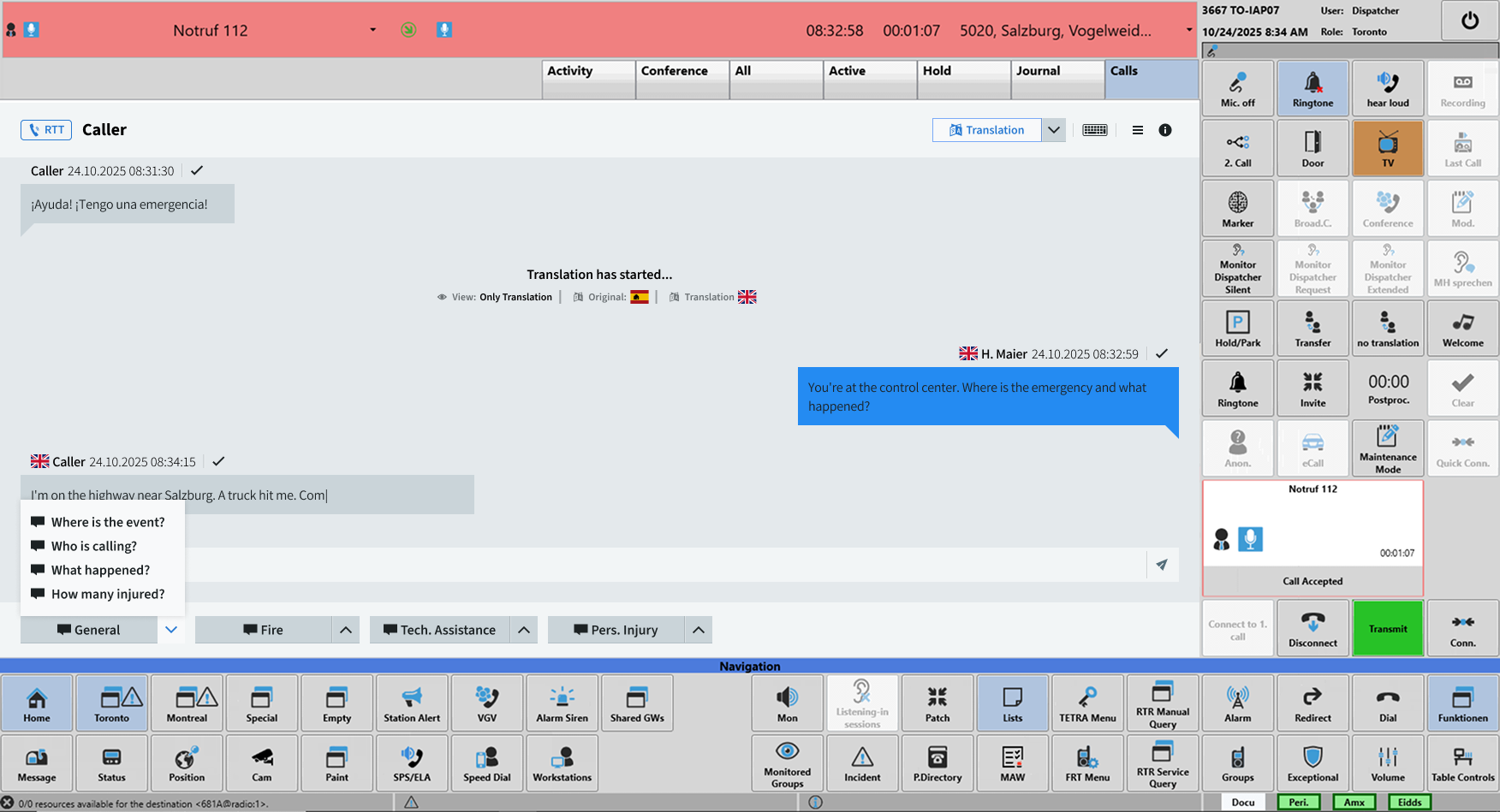
Example RTT user interface IDDS UCiP