


eIVR – eurofunk Interactive Voice Response
Structured emergency call handling during periods of high demand
Large-scale disasters, severe weather events or major public gatherings often lead to a sudden surge in the volume of emergency calls at control centres. In such high-demand situations, the workload on dispatchers increases significantly and the risk of delayed emergency call handling rises. It is therefore particularly important to prioritise incoming calls in a structured manner in order to quickly identify critical situations and deploy available resources effectively.
With eIVR (eurofunk Interactive Voice Response), eurofunk is expanding the IDDS UCiP communication platform to include an automated emergency call query system for pre-qualifying and prioritising incoming emergency calls. This enables control centres to pre-sort calls in a structured manner even before they are answered and to process them according to the situation.
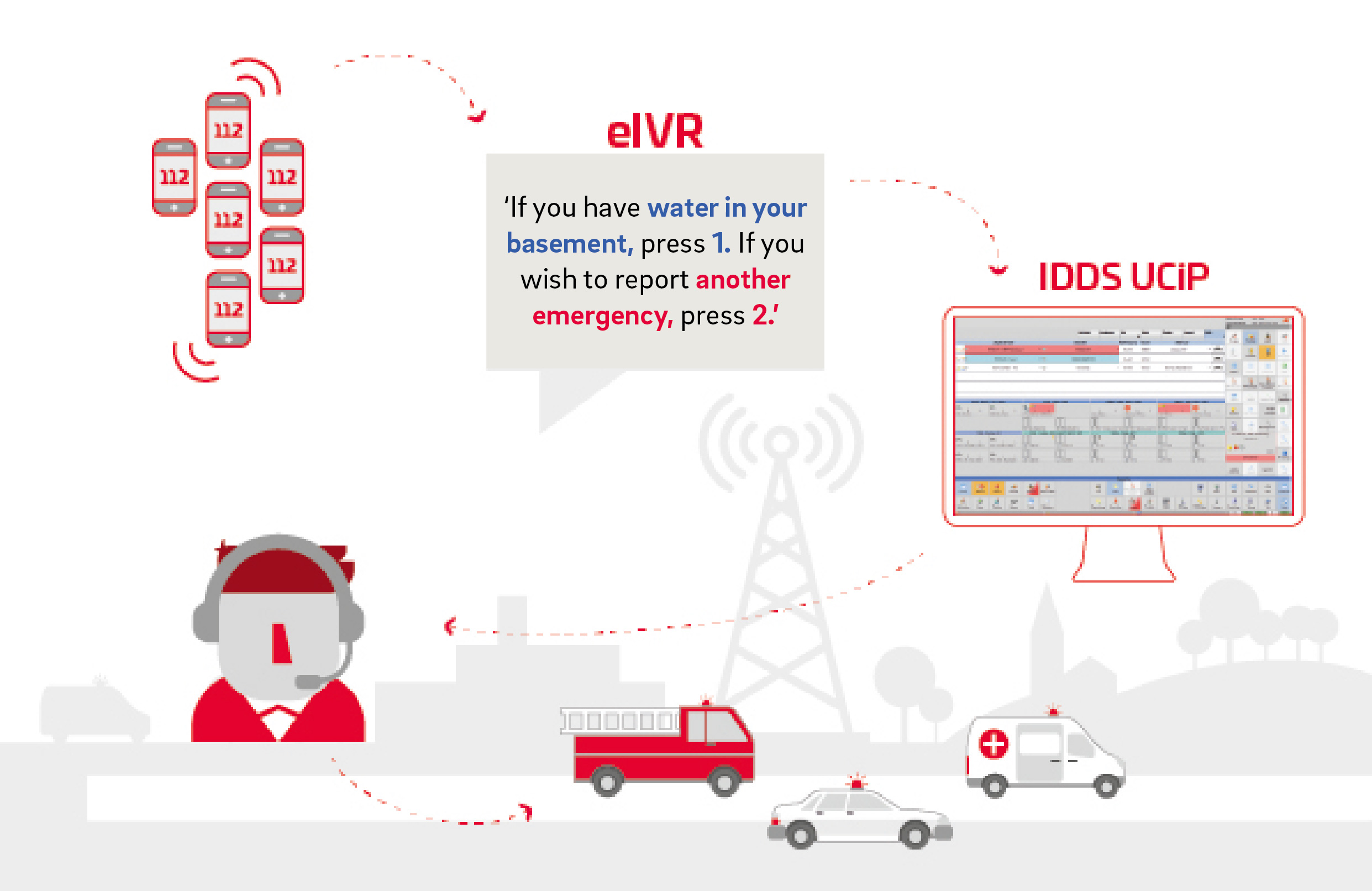
eIVR – Automated emergency call query for BOS control centres
eIVR supports control centres in managing increased call volumes and operational demands. The functional extension for IDDS UCiP (Integrated Digital Dispatching System – Unified Communications IP Platform) enables semi-automated voice dialogues for structured emergency call handling.
Callers are prompted via a voice announcement to press a defined key depending on their emergency situation. Input is via the DTMF (Dual-Tone Multi-Frequency) method and enables automated pre-qualification of the emergency call whilst the call is being answered.
Based on the input, emergency calls are, depending on the respective system configuration:
- classified by priority,
- ranked in the call list by priority,
- highlighted in colour,
- signalled to defined roles or workstations, and
- distributed specifically to the relevant control centres or departments.
This allows critical emergency calls to be identified more quickly and provides targeted relief for dispatchers during peak load situations.
Structured emergency call handling during high call volumes
eIVR supports the maintenance of stable control centre operations, particularly in the following operational scenarios:
- Severe weather and flooding situations
- Major fires
- Major traffic incidents
- Power cuts
- Major events
- Demonstrations
- Mass calls during regional incidents
Automated pre-sorting of incoming emergency calls ensures that control centres remain operational even during periods of high call volume. At the same time, available resources can be deployed more efficiently and critical incident reports can be prioritised.
Flexible configuration for different operational scenarios
eIVR offers extensive configuration options to accommodate different operational and service scenarios. Control centres can define custom voice prompts for various operational situations and activate them as required.
Configuration options include, amongst others:
- freely definable voice prompts,
- customised prioritisation schemes,
- specific key assignments for different types of operations,
- restrictions to specific call routes, such as emergency lines,
- role-based signalling, and
- situation-dependent activation of individual scenarios.
The system automatically prevents the assignment of identical digits within the same call path, thereby supporting consistent operating logic.
Administrators or shift supervisors can activate or deactivate eIVR during live operations via the IDDS UCiP Lite administration system – without interrupting control centre operations.
Benefits of eIVR for control centres
With eIVR, control centres benefit from:
- automated emergency call pre-qualification,
- prioritised handling of critical emergency calls,
- relief for dispatch during peak periods,
- structured processing of high call volumes,
- more efficient resource management,
- improved overview of call handling, and
- flexible adaptation to different operational situations.
eIVR helps control centres ensure stable, structured and prioritised emergency call handling, even in exceptional operational situations.